In 2012, Noam Wasserman published The Founder's Dilemmas. The data was unambiguous and uncomfortable: 50% of startup founders are replaced as CEO within three years of founding. By year four, only 40% remain in the corner office. Fewer than 25% ever lead their companies to IPO. Most striking of all, the more successful the startup, the more likely the founder is to be removed.
Wasserman's research landed like a grenade in the venture capital industry. It was acknowledged, debated, but ultimately absorbed into the ecosystem's accepted mythology. The price of scaling, they said. Grow or get out.
Meet the new boss, same as the old boss.
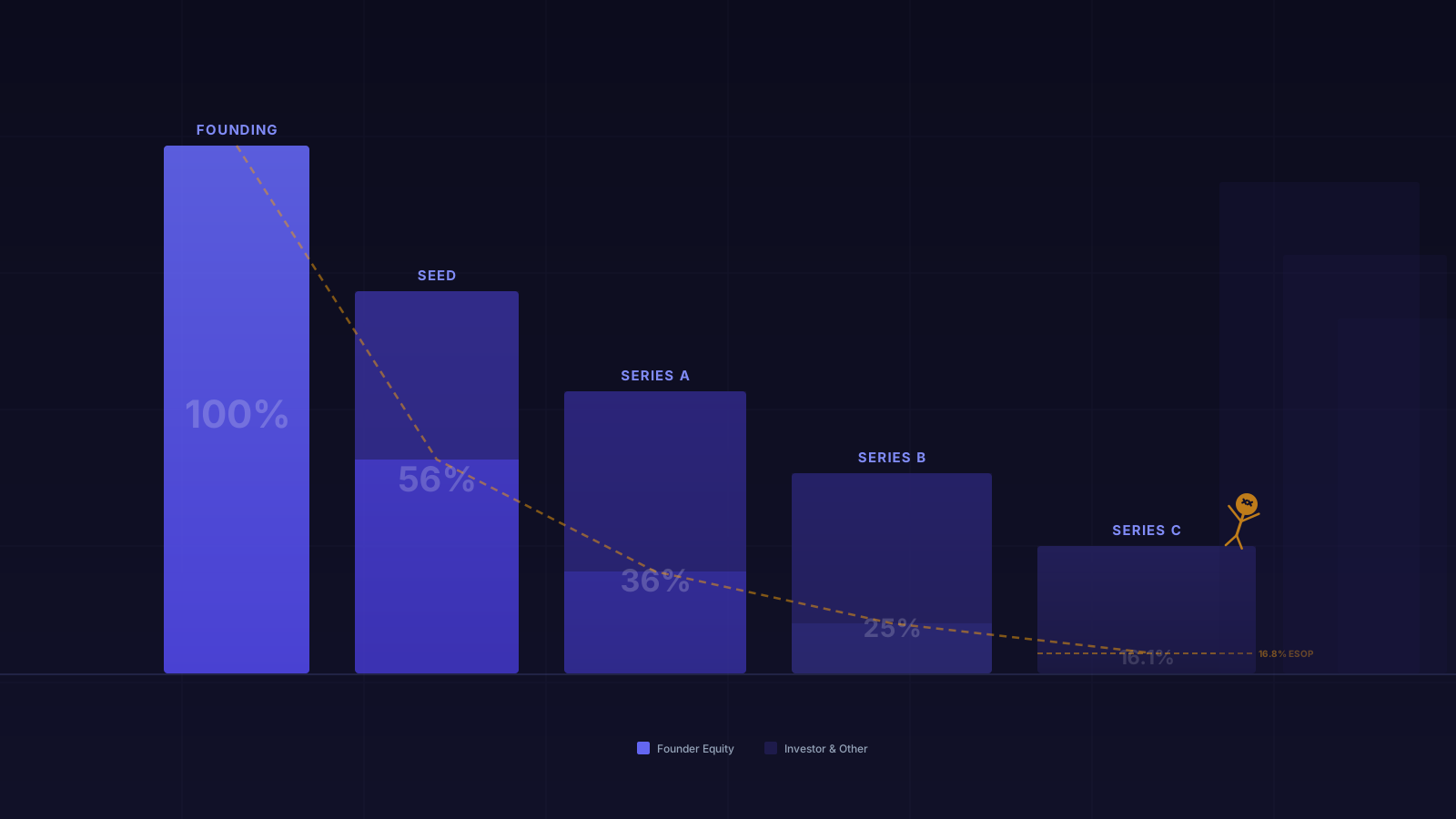
Fourteen years later, Carta published its 2026 Founder Ownership Report, laying out the ownership trajectory for venture-backed founders with characteristic precision: founding teams retain 56% of their fully diluted equity at seed stage. By Series A, that falls to 36%. By Series C, the median founder owns 16.1% of their company, less than the 16.8% held collectively by the employee option pool.
The report is a ledger of a system doing exactly what it was designed to do.
Wasserman's Data Has Not Improved
Visual companion — John Cowan, Next Wave Partners
The Structural Trajectory of Founder Ownership
Median founder ownership at each funding stage. By Series C, the founding team holds less than the employee option pool.
Source: Carta 2026 Founder Ownership Report. Fully diluted equity, median values.
Same Exit. Different Instruments. Different Outcomes.
Founder proceeds from a $50M exit after three funding rounds — traditional VC terms vs. Safer structure.
Modeled scenario from Venture Capital 2.0. Three rounds, $50M exit, comparable investment levels.
The Trajectory Is Structural
Carta's numbers are accurate. What's missing is the mechanism, the explanation for why the trajectory looks this way, and why it has looked this way for decades regardless of market conditions, fund sizes, or founder sophistication.
Each funding round in the traditional venture model does more than reduce ownership percentages. It adds a new layer of structural provisions that compound against founders over time.
Liquidation preferences are the clearest illustration. A 2x participating preferred means an investor recovers twice their investment before founders see a dollar, then participates proportionally in what remains. Consider a company that raises $10M on those terms and exits for $40M. The investor takes $20M off the top, then participates in the remaining $20M according to their ownership share. In a modest exit, these preferences can consume 60–80% of total value for investors holding just 25% of shares.
Anti-dilution ratchets transfer ownership from founders to investors whenever a subsequent round prices below the previous one. In the current environment, where down rounds reached a decade high of roughly 20% in 2025 according to PitchBook data, full ratchet provisions can be devastating. A full ratchet on a round originally priced at $10 per share, repricing to $5 in a down round, effectively doubles the investor's share count, diluting founders by 30–50% in a single financing event as punishment for market conditions entirely beyond their control.
Board composition shifts with each round. Investors holding 20% of equity may control 60% of board seats. The governance architecture, once tilted, rarely corrects itself.
The cumulative effect is what Carta's data shows: by Series C, the founding team has been systematically dispossessed of the company they built. The 16.1% figure is the mathematical endpoint of instruments engineered for extraction.
Dilution Precedes Displacement
Ownership erosion is a governance problem as much as a financial one. As founder equity shrinks, so does their leverage at the board table. The progression is predictable: early rounds preserve founder control; later rounds transfer it. By the time a founder holds 16% of their company against institutional investors holding the remainder, the structural conditions for removal are fully in place.
Wasserman documented that founders are removed despite succeeding. The mechanism is misalignment: investors with different time horizons, return hurdles, and portfolio pressures make decisions that serve their economics over the company's long-term health. A founder resisting a premature exit or a strategic pivot that benefits one investor class over others is doing their job. By that stage of the funding lifecycle, they rarely have the governance position to hold the line.
The result is the paradox Wasserman identified in 2012:
Founder-led companies consistently outperform professionally managed peers on capital efficiency, innovation velocity, and total shareholder returns. S&P 500 companies with active founders have outperformed the rest of the index by 3.1x over the past fifteen years, and the system removes founders anyway.
Carta is publishing the same story in 2026.
The Question Carta's Report Doesn't Ask, and Won't
Carta's data is built from a platform of tens of thousands of startups. It is the most comprehensive picture of founder dilution available. The report is silent on one question that matters more than all the numbers combined:
What would these ownership trajectories look like under a different set of instruments?
The Carta report implicitly treats priced equity rounds with standard terms, like liquidation preferences, anti-dilution provisions, board control transfers, as the natural state of venture finance. They are not. They are a set of design choices that crystallized when Kleiner Perkins opened the first venture firm on Sand Hill Road in 1972 and the limited partnership structure became the industry template. The preferred stock provisions, the waterfall mechanics, the governance extraction playbook, etc., were engineering decisions made by a specific group of people solving for a specific set of incentives. The fact that every law firm now uses the same NVCA model term sheet template does not make those terms inevitable. It makes them a convention.
Presenting dilution data as neutral fact conditions founders to accept structural dispossession as the cost of building a company. It is the cost of building a company using these particular instruments. That distinction is the whole argument.
A Different Architecture Produces Different Numbers
I've written extensively about what I call the Law of Venture Reciprocity: sustainable venture creation requires that value capture be proportional to value creation across all stakeholders. The instruments we use must reflect that principle, or they work against it.
Revenue-based instruments like the Safer (Simple Agreement for Future Equity with Repurchase) are the structural embodiment of this principle. Under a properly structured Safer, investors receive a revenue participation rate tied to company performance up to a defined return multiple, alongside residual equity participation at a valuation cap. The mechanics matter:
Revenue-based returns do not compound dilution through multiple rounds. There are no anti-dilution ratchets, no ownership transfers triggered by market conditions. Liquidation preferences do not stack across financing events. Board control provisions do not enable governance extraction through forced exits.
The comparative math is significant. Take a company that reaches a $50M exit after raising three rounds. Under traditional terms, with 1x participating preferred at each round with standard anti-dilution and board provisions, the waterfall calculation routes roughly 65% of exit proceeds to investors holding 40% of equity, leaving the founding team with approximately $8M on a $50M outcome. Under a Safer structure at comparable investment levels, with revenue participation already returning a portion of investor capital pre-exit, founders retain roughly $22M of the same $50M exit. The instruments, not the outcome, determine who captures the value.
Across modeled scenarios in Venture Capital 2.0, this pattern holds consistently: founder economic outcomes are 10–13x superior under Safer-structured financing at comparable exit values, because the extraction mechanisms that consume value in the waterfall calculation are eliminated at the instrument level.
Carta's data shows founders arriving at Series C with 16.1% of their companies. That is a structural outcome. Change the instruments, and the trajectory changes with them.
The Industry Has the Data. It's Missing the Diagnosis.
Carta publishes some of the most valuable venture data available. The 2026 Founder Ownership Report is a genuine contribution to the ecosystem's self-understanding. But accurate data in service of a flawed frame produces informed acceptance of a broken system.
Founders reading Carta's report will absorb the dilution trajectory as an expected pattern, the road ahead, to be managed and negotiated at the margins. What they deserve to know is that the trajectory is a choice. The system that produces it is a set of instruments designed by people, and it can be redesigned by people.
Wasserman told us in 2012 that the system was removing the founders it needed most. Carta is telling us in 2026 that the same system is still dispossessing the people who build the companies it claims to finance.
The data has not improved because the instruments have not changed. That is the problem worth solving.