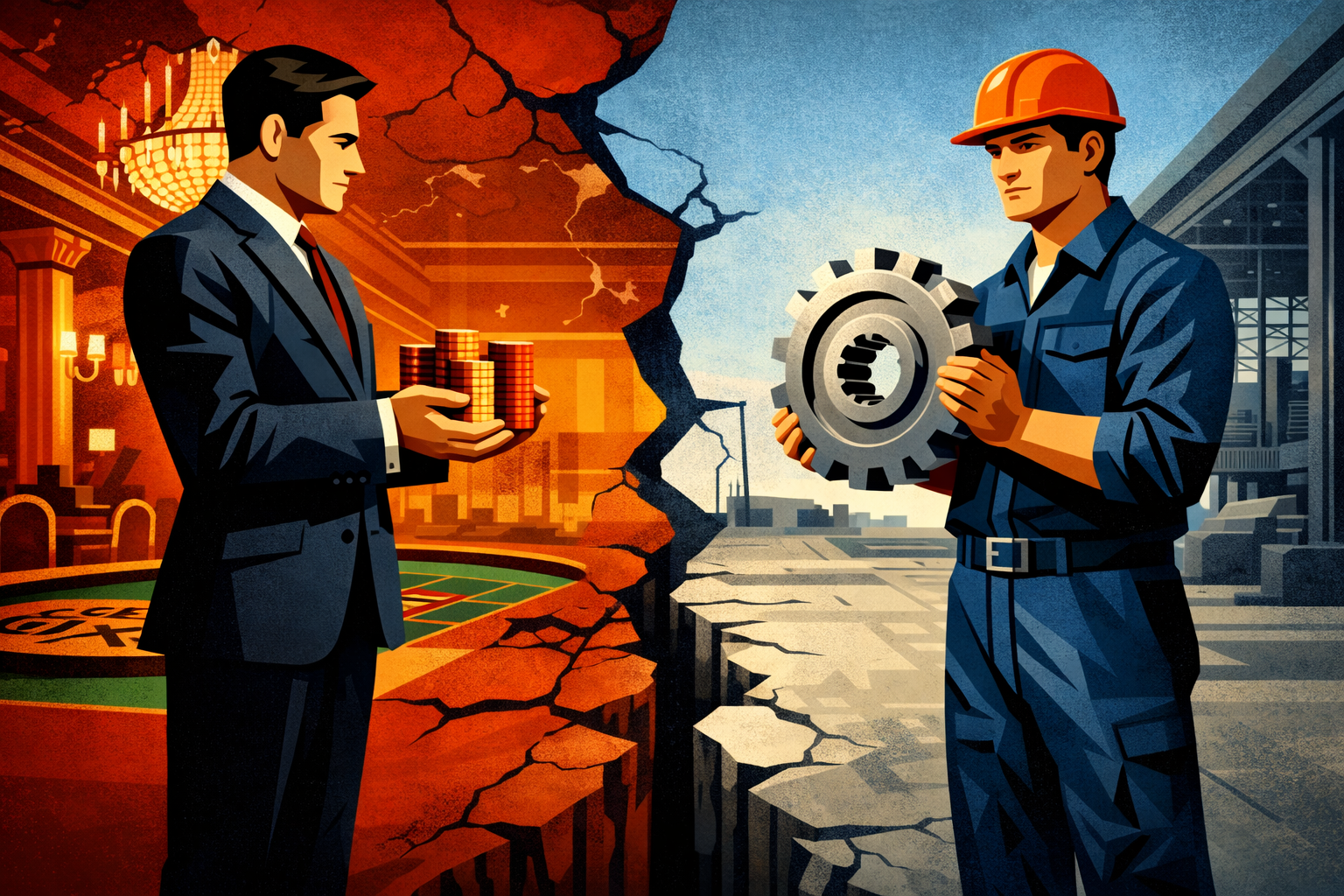
Dan Gray's "No Crying in the Casino" is the sharpest piece I've read on venture capital's structural rot in months. His core argument, that financialisation has turned the startup economy into a casino and that reindustrialisation is the only escape, is exactly right. Gray traces the lineage from 16th century bullionism through Perez's technological revolutions to the present moment with surgical precision. He names what too many in the industry won't: that "software eats the world" was really "finance eats the world," and that the iRobots of the economy have been hollowed out by the preference for accumulation over production.
I agree with every word of his diagnosis. Where I want to push further is on the prescription.
Gray ends with a call to reindustrialisation, the rallying cry of technologists building uranium enrichment plants, marine robotics startups, and drug discovery labs. These are exactly the right companies. But as one of his commenters astutely observed: reindustrialisation is incomplete without a goal bigger than shareholder value. Otherwise, you just rebuild the same loop.
I'd go further. You can't reindustrialise with financialised capital. The instruments, structures, and incentive systems that created casino culture don't stop being extractive just because you point them at hard tech instead of SaaS. The problem isn't merely where capital flows. It's how capital behaves once it gets there.
The Financialisation of Everything
Gray roots financialisation in policy: deregulation, quantitative easing, the preference for accumulation over production. He's right, but the rot goes deeper than policy. It's become the operating logic of every sector capital touches.
I've written previously about what I call the financialisation of everything, the systematic transformation of every aspect of economic life into a financial product. It began in 1971 when Nixon closed the gold window, unmooring money from any connection to real assets. The 1974 ERISA Act opened pension funds to Wall Street management. The 1982 Garn-St. Germain Act deregulated savings and loans. The 1999 repeal of Glass-Steagall completed the transformation. By 2002-2007, financial sector profits reached 40-44% of all U.S. corporate profits, up from less than 10% in 1947. But these profits didn't come from funding productive enterprises. They came from securitizing debt, packaging risk, and extracting fees from the movement of money itself.
Finance had discovered it could make more money from money than from anything money might actually build.
Gray's iRobot case study is a perfect microcosm of this. A DARPA-funded MIT robotics spinout, responsible for defusing IEDs in Afghanistan and search and rescue after 9/11, was systematically hollowed out. The company shed factories, cut R&D, redirected free cash flow into stock buybacks to inflate EPS, and repositioned as a "smart home" company with better valuation multiples. The competitive moat that came from genuine engineering was replaced by a financial moat of metrics manipulation. When the product advantage eroded, there was nothing left. This is the playbook that financialisation runs on every industry it touches: education, housing, healthcare, and now venture capital.
Student debt illustrates the pattern at scale. When Reagan cut federal education support by 25% in the early 1980s, shifting emphasis from grants to loans, he created raw material for Wall Street. Universities could raise tuition indefinitely because loan availability sets the price ceiling. The loans were immediately securitized and sold, meaning lenders had no stake in whether students could ever repay. Housing underwent the same transformation: traditional mortgages became inputs for mortgage-backed securities, then synthetic CDOs. Healthcare was perhaps the most perverse: private equity now owns over 30% of emergency rooms and controls practices covering 40% of certain specialties, extracting from illness rather than treating it.
This matters for reindustrialisation because the same financial engineering is already being applied to venture capital. The fundamental structure of ten-year funds demanding 10x returns through power law exits has nothing to do with building companies and everything to do with manufacturing valuations. VCs don't celebrate when portfolio companies become profitable. They celebrate when they raise their next round at a higher valuation. The product is the markup.
Point this same machinery at nuclear startups or marine robotics companies and it won't magically start behaving differently. It will financialise them.
The Option Premium Problem
But here's where Gray's casino metaphor needs sharpening, because not all speculative capital is the same.
My business partner James Thomason has developed what he calls the option premium view of bubbles, and it offers a crucial distinction that Gray's framework misses. Drawing on Cornell and Damodaran's research and Perez's long wave analysis, Thomason argues that installation-period speculation serves a genuine productive function. Each startup funded during an installation period is essentially an option on a different configuration of the technology. Most will expire worthless. But the few that succeed generate knowledge that cannot be obtained any other way.
The dot-com bubble destroyed trillions in paper wealth. But it also built the infrastructure, trained the workforce, and ran the experiments that powered Amazon, Google, and two decades of digital commerce. Britain's railway mania bankrupted hundreds of companies. But by 1850, Britain had the rail network that powered its economy for a century. The option premium gets paid during installation. The returns get realised during deployment.
This distinction matters enormously for how we think about the current AI build-out. Microsoft is spending $80 billion on AI data centres in a single year. Amazon, Google, and Meta are each planning similar levels. OpenAI's Stargate project has announced $500 billion in infrastructure commitments. Is this rational? Nobody knows. That's the point. The option premium buys something that cannot be obtained any other way: parallel exploration of the possibility space.
But here's the critical caveat that Thomason identifies. The option premium only generates productive knowledge when the financial instruments allow the knowledge to be captured and deployed. Railway mania produced a permanent rail network because rails are physical infrastructure. The dot-com bubble produced lasting companies because some of them, like Amazon, were structured to survive the correction and compound what they'd learned.
Venture capital's current financial architecture does something different. It extracts from the option premium rather than capturing it. When $437 billion flows into AI at 25-30x revenue multiples, the deployment-to-exit ratio hits 3.2:1, and the response is to repackage impaired assets into continuation vehicles, the knowledge generated by the option premium doesn't compound. It gets consumed by fees, deferred by financial engineering, and trapped in structures that can never clear.
GP-led secondaries exploded from $6 billion in 2016 to $67 billion in 2023. Continuation vehicles now represent 88% of GP-led secondary volume. According to a University of Chicago study, 80-90% of LPs offered the chance to roll into continuation vehicles choose to cash out instead. The investors with the most information about these assets are voting with their feet.
The Continuation Vehicle Explosion
secondary volume
80-90% of LPs offered the chance to roll into continuation vehicles choose to cash out instead. The investors with the most information about these assets are voting with their feet, accepting 20-40% discounts to escape. When sellers outnumber believers by that margin, it suggests something beyond normal market dynamics.
Goldman Sachs just paid $665 million for Industry Ventures, the firm that industrialised this process. They didn't buy confidence in venture. They bought the mop company for a market that produces blood on the floor as a business model. Goldman doesn't need venture to recover; it needs venture to keep restructuring.
Do you like my work? Please consider upgrading to Venture Capital 2.0 Premium and I'll send you a copy of my book, Venture Capital 2.0! I am grateful for your support! 🙏
Gurley Was Right, and the Ride Isn't Over
Gray opens with Bill Gurley's 2015 warning about a "risk bubble." Not a typical speculative frenzy, but the slow accumulation of risk through later and larger rounds, delayed exits, and ever-growing pools of capital postponing reckoning. Gurley was right. And the data since has only vindicated him more brutally than even he might have expected.
The numbers are not debatable. Total venture funding collapsed from $67.9 billion in Q4 2021 to $21.3 billion in Q1 2025, a 69% decline. The percentage of seed-stage companies reaching Series A has fallen to just 1%. Forty-six percent of seed rounds are now bridge rounds to nowhere. Meanwhile, 81% of capital raised goes to established firms raising $500 million or larger funds.
The recent AngelList data makes this concrete. Across every vintage from 2017 through 2024, the median fund has returned less than thirty-eight cents on the dollar to limited partners. The 2021 vintage, funds raised at the peak of ZIRP, shows a median TVPI of just 1.09x and an IRR of 2.2%. The gap between what VCs tell their LPs their portfolios are worth (TVPI) and what they've actually returned in cash (DPI) has become a structural feature, not a temporary lag.
Thomason's framework explains why: we're deep in the installation period of the AI wave, paying an enormous option premium. But venture capital's financial architecture ensures that most of that premium is captured as fees rather than converted into productive knowledge. The saw-tooth pattern Gurley identified isn't just a feature of the bubble. It's a feature of the instruments. The 10-year blind pool structure, the 2-and-20 fee model, the binary exit dependency: these create the saw-tooth by design. You can't smooth the ride without replacing the tracks.
The Gap Between Promise and Payment
The 2021 vintage may be the first to lose money since 2000. Funds deployed at peak ZIRP valuations show a median TVPI of just 1.09× and an IRR of 2.2%. Even the oldest cohort, 2017, now eight years old, has returned just $0.31 for every $1.00 invested. The highest median DPI across all vintages is 0.38×, less than forty cents on the dollar after seven years.
The Missing Architecture
Perez's framework has a gap that matters enormously for reindustrialisation: the deployment period doesn't just require different companies. It requires different financial instruments. The installation period optimises capital instruments for speculation. The deployment period needs instruments optimised for production.
Thomason identifies the key constraint: the option premium only creates lasting value when the infrastructure it builds persists through the correction. Railways persist because they're steel and earth. The AI data centres being built today will persist as physical infrastructure. But the financial structures wrapped around them, the ten-year funds, the preference stacks, the continuation vehicles, these don't persist. They consume value through fees and financial engineering, then collapse, leaving the knowledge they generated scattered rather than compounded.
What do production-oriented instruments look like? They need to do three things that traditional venture equity cannot.
First, they need to return capital through operational performance rather than exit events. A company building intelligent infrastructure or autonomous logistics doesn't need to be acquired or go public to be valuable. It generates revenue. Its investors should participate in that revenue, not wait a decade hoping for a liquidity event that statistically won't arrive.
Second, they need to align the time horizons of capital with the time horizons of the underlying technology. Nuclear renaissance companies, deep tech robotics, and novel materials science don't mature in 5-7 years. Capital structures that expire in 10 years and demand exits by year 7 are structurally incompatible with reindustrialisation.
Third, they need to eliminate the governance pathologies that financialised structures create. Preference stacks, anti-dilution ratchets, board control that exceeds economic ownership: these mechanisms were designed for a world where capital was scarce and exits were plentiful. That world no longer exists. In the reindustrialised economy, governance must align stakeholders around long-term value creation rather than zero-sum competition for finite liquidation proceeds.
Revenue-linked instruments, what we call Safer structures (Simple Agreement for Future Equity or Revenue), accomplish all three. A Safer investment takes 2-3x return through revenue participation over 5-7 years, with residual equity upside if exits materialise. It transforms venture from lottery tickets to yield assets with optionality. The investor gets paid as the company produces value, not when a greater fool appears at the exit.
This is a paradigm shift in how capital relates to production.
Builders Need Builder Capital
Gray closes with a vision of "great industrialists" who operate on the frontier, idealists whose vision supersedes the shallow incentives of finance. I share this vision. But great industrialists need financial partners who operate with the same long-term orientation. And traditional venture capital, by its structure, cannot be that partner.
The venture studio model provides an alternative, as I wrote about in my book Venture Capital 2.0. Studios don't deploy capital from a distance and demand exponential returns. They co-build companies with deep operational involvement, amortizing infrastructure costs across portfolios, and generating returns through systematic value creation rather than statistical gambling. Studio data shows average IRRs of 53-60%, compared to 21-33% for traditional VCs, with failure rates as low as 9% versus 75%.
These numbers matter because they demonstrate something Thomason's option premium framework predicts: when you replace speculation with operational involvement, you convert more of the option premium into lasting value. Studios run fewer experiments, but the experiments they run produce higher-fidelity knowledge because the studio is embedded in the company, learning in real time, and applying that learning across the portfolio. The knowledge compounds rather than scattering when individual companies fail.
When you combine the studio operating model with revenue-linked instruments and permanent capital vehicles that don't expire, you get something genuinely new: innovation finance designed for production rather than speculation. Capital that captures the option premium Thomason describes without the extractive financial architecture that currently consumes it.
Gray writes that "finance will bend to [the industrialists'] needs, rather than vice-versa." He's right. But finance won't bend voluntarily. It will bend because new financial architecture forces it to. Because revenue-linked instruments make extraction uneconomic, because permanent capital structures remove the expiration dates that force bad exits, because operational involvement creates returns that don't depend on casino dynamics.
The Fork in the Road
We're at a genuine inflection point. The casino culture Gray describes so well isn't going to reform itself. The incentives are too strong, the fee streams too lucrative, the institutional inertia too deep. Andreessen Horowitz just raised $15 billion. The megafunds will continue to concentrate capital, inflate valuations, and defer reckoning through increasingly elaborate financial engineering.
But parallel to this, exactly as Gray suggests Perez would predict, a different ecosystem is emerging. Studios are building infrastructure companies with revenue-linked capital. Family offices and angels funding reindustrialisation through instruments that return capital through performance. Regulation Crowdfunding platforms enabling democratic participation in wealth creation rather than gambling.
Gray identifies the most important dynamic in his closing section: this could be the first time an industrial economy has quietly emerged in parallel to a financial economy, with the two in competition for capital and talent. He's right. And the outcome depends not just on whether we build the right companies, but on whether we fund them with the right instruments.
The extraction economy is eating itself, consuming its own feedstock until nothing remains to be financialised. The option premium for the AI wave is being paid at unprecedented scale, but venture capital's current architecture ensures most of it will be consumed by fees rather than converted into productive infrastructure. The technologists Gray celebrates, the uranium enrichment builders, the marine robotics founders, the drug discovery scientists, are already at work. The question is whether the capital that funds them will be structured for production or extraction.
You can't build the deployment period with installation-period tools. The reindustrialists need reindustrialised capital. That's the work.
I am a Founding Partner of Next Wave Partners. This article was written in response to Dan Gray's "No Crying in the Casino," published February 22, 2026, and draws on James Thomason's work "The Option Premium View of Bubbles."