In January 2024 I wrote Venture Reciprocity. The argument was that venture capital mistakes equity for the basis of the founder-investor relationship. Because equity returns are unpredictable, investors price risk "absurdly high," and that price comes "directly out of the pocket of the company's founders." I said the problem ran along two vectors: how much is returned, and how long it takes. Value and time. I wrote about those vectors from the investor's side, and argued that founders absorb the cost.
In March I followed with a piece on Carta's 2026 founder ownership data: the median founding team holds 56 percent at seed, 36 percent at Series A and 16.1 percent by Series C, less than the 16.8 percent held by the employee option pool.
That piece described the path, not the destination. Ownership tables show what founders hold on the way. They do not show what founders actually take home. And Venture Reciprocity made its case from first principles, without a ledger to check it against.
Now we have that number.
A working paper by Eduardo Azevedo and Kent Smetters at Wharton and Florian Scheuer and Min Yang at the University of Zurich, Dilution vs. Risk Taking: Capital Gains Taxes and Entrepreneurship (July 2026 version), builds on Hall and Woodward's earlier work to produce something not previously available at this scale: the full distribution of exit payoffs at the level of the individual founder, across 157,669 U.S. venture-backed companies and 248,454 founders from 1987 to 2025, assembled from SEC filings, PitchBook, CB Insights, PrivCo, Capital IQ and Compustat.
It is the founder's ledger. And it is worse than I thought.
The value vector
Here is what the ledger shows from the founder's side.
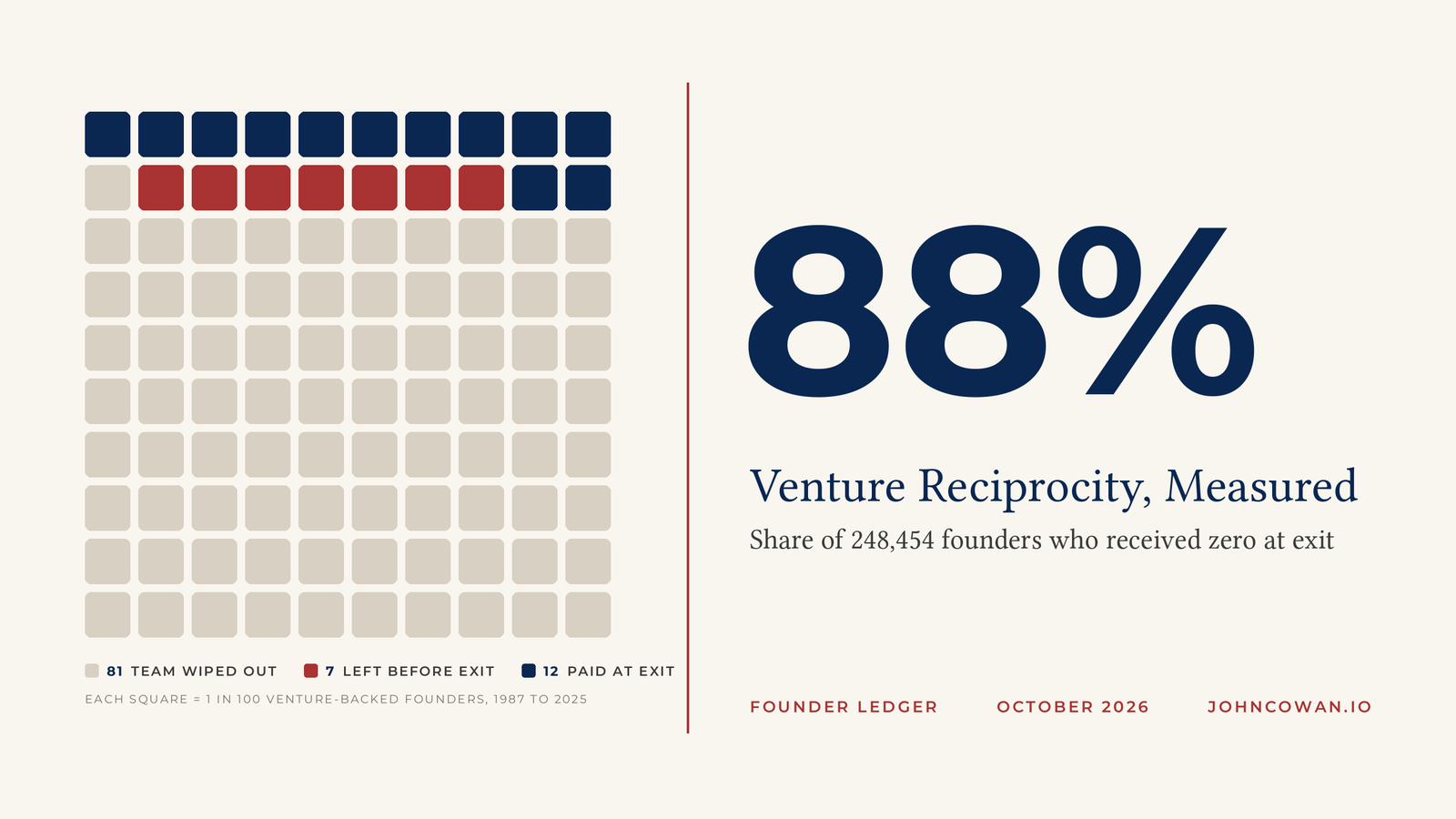
88 percent of venture-backed founders receive zero at exit.
Wait. What?
That is not 88 percent of companies. It is 88 percent of the people who started them. It comes from two failures stacked on top of each other.
First, in 81 percent of cases the founders are collectively wiped out. Most of those companies simply fail, and no financing instrument fixes failure. But the authors are explicit that founders get zeroed "significantly more often than companies are a complete failure," because venture contracts protect investors in weak outcomes. Their dilution model incorporates anti-dilution provisions and preferences, and the result shows up even among real exits: in 19 percent of IPOs and acquisitions, the founders' collective share is zero, because investor protections triggered by down rounds before the exit absorbed it.
Sit with that one. In nearly one in five exits the paper counts as successful, the company sold or listed, investors took the proceeds, and the founders got nothing.
Second, even when the founding team as a whole is paid, there is a 39 percent chance that any individual founder has already left and receives nothing. The authors find this in the S-1 filings of 1,300 IPO companies: people tagged as founders in the commercial databases do not appear among the shareholders at listing, even though their co-founders do. The paper assumes these dropouts receive zero, and notes that some may have sold privately before the IPO or fallen below reporting thresholds, so this piece of the estimate may overstate how many of them leave with nothing. It measures departure, not removal, so it cannot say how many were pushed out. But it puts a price on leaving early: on these assumptions, nothing.
The two failures reconcile. Start with the 81 percent of founders whose teams are wiped out. Among the teams that are not, 39 percent of individual founders are already gone, which adds about 7 points. Together that is roughly 88 percent.
Among the founders who do get paid, the distribution is extreme. Conditional on a positive payoff, the median is $4.8 million and the mean is $47.3 million. Across everyone, the top 1 percent of founders capture 79 percent of all founder exit value, and the top 2 percent capture 89 percent. The upper tail follows a Pareto distribution with a coefficient of about 1.0 for individual founders and 1.1 for companies, which the authors describe as more unequal than U.S. income or wealth.
Then the milestone that should change how founders read their own term sheets. Even among companies that reach a $100 million valuation in a pre-exit round, there is still a 32 percent probability that the company's eventual exit value is zero. That is the company, as the paper's appendix makes clear. The founder's odds are worse, because dilution and departures still apply to the companies that do return something.
A $100 million mark is not a win. One in three of those companies still exits at zero, and the founder's odds are worse than the company's.
The time vector
The second vector in Venture Reciprocity was time. Equity makes investors wait, and an investor who waits too long starts doing damage: forced liquidations, premature exits, recapitalizations.
The paper measures how long the bet runs. The raw average life of exited companies in the data is 8.1 years, but that number is biased, because many companies have not exited yet. Correcting for that with a hazard model, the authors estimate an exit rate of 6.2 percent per year, which implies an average time to resolution of 16.1 years.
That number needs reading carefully. It is the time to any outcome, shutdown included, not the wait for a payout. Companies that did reach an IPO or an acquisition averaged 7.4 and 7.9 years in the data. But sixteen years is the right number for a founder deciding whether to commit a career, because it is how long, on average, the bet takes to settle one way or the other. It is long enough for a founder to be replaced, for a preference stack to be rebuilt more than once, and for investors to develop a reason to want a different outcome than the founder does. The time vector is not an inconvenience. It is the operating condition under which the Venture Capital Ethos does its work.
What a rational founder would pay
The most striking result in the paper is not a payout figure. It is what a rational founder should be willing to give up for this bet.
On average, the venture lottery is worth roughly $350,095 in expected equity value per year of founder work. A risk-neutral person would take it unless the job they left paid at least $350,095 a year more than the founder salary.
Founders are not risk-neutral. In the authors' career-choice model, with a moderate level of risk aversion and with wages and wealth calibrated to the population of potential founders using Census and Federal Reserve survey data, a founder at the median wage values the entire venture payoff at 8.1 percent of its expected value. That founder would accept at most a $28,197 annual pay cut to start a company.
The benchmark in this literature has been Hall and Woodward's 2010 study, which found entrepreneurship had positive expected value even for people giving up very high salaries. The new paper finds returns well below that. Even restricting to Hall and Woodward's own 1987 to 2008 window, the results are significantly lower, and the authors attribute the remaining gap mainly to better coverage and less reporting bias in modern data.
So the mythology has a number now. Equity is presented to founders as the most valuable thing they own. A rational, risk-averse founder prices it at about eight cents on the dollar.
Equity is the wrong basis of reciprocity
This is the core claim of Venture Reciprocity, and the data is consistent with it. The paper compares tax regimes, not financing instruments, so it cannot prove the claim. But it shows where the current instrument leaves founders.
When equity is the only currency of the relationship, everything is settled at the exit. Investors protect themselves against that uncertainty the only way the instrument allows: preferences, ratchets, control and a 10x pricing assumption. Each protection moves risk from the investor to the founder. Most of the 81 percent is ordinary company failure, and that is the cost of trying hard things. The part of the data that measures the instrument is the 19 percent of real exits where the company sold or listed and the protections left the founders nothing. That is where investor risk lands on founders.
The authors raise a question in passing that deserves more attention than it will get. Their model shows that taking some value off the jackpot and delivering it in bad outcomes instead can leave more risk-averse founders better off, even when it lowers the average payoff. In their version, founders with moderate risk aversion come out roughly indifferent, because that insurance is priced unfairly. The design decides the result. So why do venture contracts not already share risk this way? They suggest low founder risk aversion, moral hazard or adverse selection.
I would add a fourth answer: the instrument. Equity cannot deliver cash before the exit without a secondary sale, a dividend or a redemption, and the traditional fund is not built to want either. The incentive runs the other way. Fees scale with capital under management, portfolio construction assumes a power law, and a manager hunting for the one company that returns the fund has little reason to trade jackpot for certainty on behalf of the founder.
Programming reciprocity
In 2024 I asked: "What if early stage investors, who often take the greatest risks, were to receive nearer-term returns calibrated to the amount of the risk actually taken?"
The founder ledger gives a second reason to ask. Go back to the price founders put on the bet. A founder who values about $350,095 a year of expected equity at no more than a $28,197 pay cut is discounting the whole bet roughly twelve to one. That ratio is my arithmetic on the paper's figures, not the authors' claim. It is an average discount on the entire payoff, not the value of moving any single dollar, but it shows how little of the headline equity value reaches a risk-averse founder.
The paper's own scenarios show how much the design of the downside matters. Those scenarios concern how taxes treat losses, not financing terms, but the lesson carries over. A design that returned money to founders after losses raised entry into entrepreneurship by 12 percent, even though average payoffs fell. A version that only carried losses forward cut entry by 38 percent. Same company outcomes. The way risk was shared decided the result.
I want to be careful here. The paper does not study revenue-indexed instruments. And the authors' own caveat applies to any structure that pays founders more in bad outcomes: under moral hazard, a contract that rewards outcomes less sharply can weaken the incentive to perform. Earlier cash has a real price.
The Safer is not founder insurance. It makes no payment to founders when a company fails. Its effect is indirect, and it runs through the 19 percent. Investors build preferences, ratchets and protections because equity gives them only one chance to recover capital: the exit. If investors recover capital from revenue before the exit, they have less reason to build the protections that zero out founders when the exit disappoints. Investors want predictability across value and time. Founders want to still be on the cap table when the money arrives. Those preferences are not opposed.
That is what revenue-indexed repurchase structures like the Safer are designed to do: return investor capital from operating performance and leave residual upside in place, so that neither side has to win the lottery to be made whole. In the modeled scenario I published in March, the same $50 million exit after three rounds left founders with roughly $8 million under 1x participating preferred terms and roughly $22 million under a Safer structure, because revenue participation had already returned part of the investor capital before the exit. That is a model, not an observed outcome, and it depends on the company producing revenue that can carry the repurchase. Not every company can. But it shows where the value goes when the instrument changes.
Measure the founder, not just the fund
Venture has an LP scoreboard. TVPI, DPI and IRR tell investors how the fund did. There is no equivalent scoreboard for the people who build the companies, which is part of why the numbers in this paper surprised anyone.
If Venture Capital 2.0 means anything, it should mean measuring the founder side of the ledger with the same discipline. Three numbers would do it:
Founder recovery rate. The share of founders who receive any cash from their equity, at any point. The paper's closest measure, founders with any exit value at all, is 12 percent under today's system.
Founder cash before exit. Value delivered to founders before a liquidity event, through salary catch-up, secondary sales or programmatic distributions, as a share of their total payoff.
Departure cost. The difference in payout between founders who stay through an exit and founders who leave, whether by choice or not. On this data, a founder who departs before an IPO is assumed to receive nothing.
A financing that improves these numbers is founder-aligned, whatever its marketing says. A financing that does not is not.
The data has caught up with the argument
Wasserman showed how often founder CEOs are replaced. Carta shows how founder ownership erodes. This paper shows where the road ends: for nearly nine founders in ten, at zero, on a bet that takes about sixteen years to settle.
Failure is not the problem. Hard companies fail. The problem is the share of real exits where the company succeeds and the founders still get nothing. That part is not a law of nature. It is the output of a specific set of instruments, applied consistently for decades. The argument in Venture Reciprocity was that founders and investors should be bound by returns, not just by equity, because returns that arrive sooner make both sides less dangerous to each other.
We used to make that argument with anecdotes. Now we can make it with a ledger.
Disclosure: I am a co- founder of Next Wave Partners, which builds, operates and finances companies, including through Safer instruments. This essay is for discussion and education only. It is not investment, legal or tax advice, and it is not an offer to sell or a solicitation to buy any security. Founder outcome figures are drawn from the cited working paper (July 2026 version); dollar figures are reported by the authors after current-law taxes, and the founder valuation figures come from the authors' calibrated model. Safer comparisons are modeled scenarios, not observed results.